Introduction: The Architect Behind the Ottoman Rise
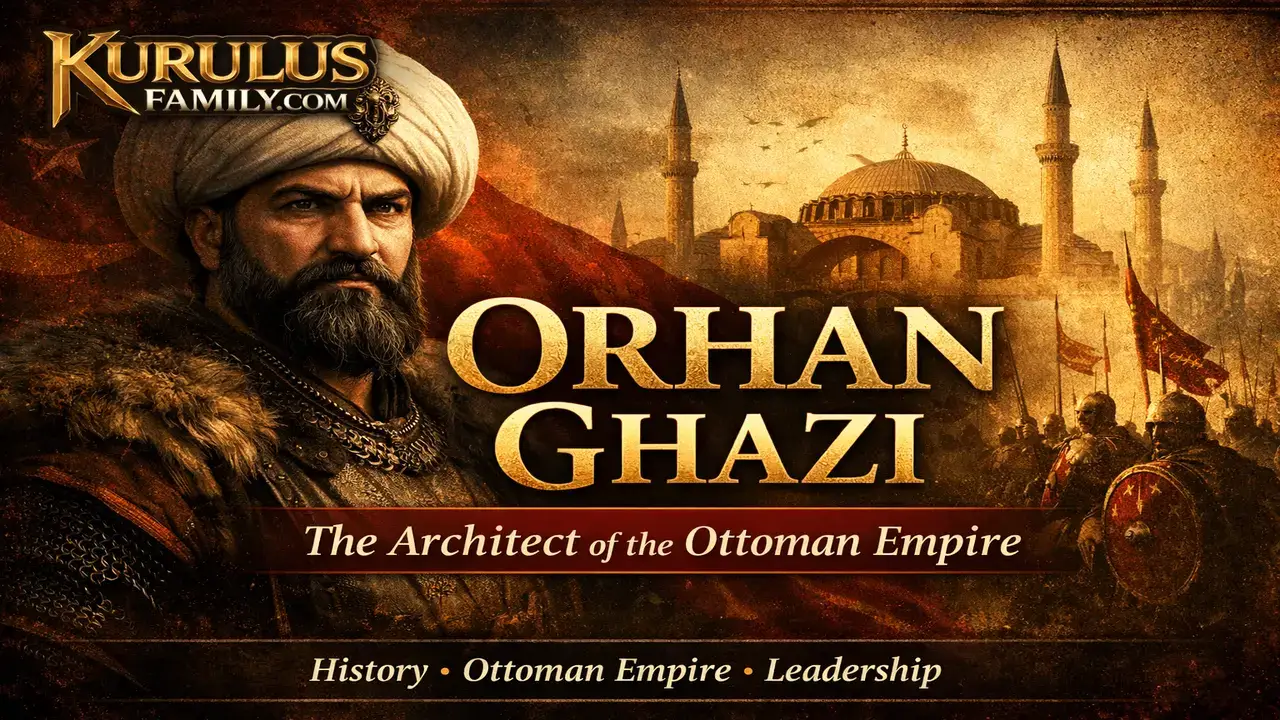
History often celebrates founders, but empires endure because of those who build systems, not just victories. Osman Ghazi secured a fragile frontier principality on the edge of the Byzantine Empire. His son, Orhan Ghazi, inherited that uncertainty and turned it into structure.
When Orhan came to power in the early 14th century, Ottoman authority remained local and fluid. By his death, it had a capital in Bursa, a functioning administrative system, and a foothold in Europe.
While Osman secured territory, Orhan made it governable. His reign shows that expansion without administration does not produce an empire—it produces instability.
Early Life on the Byzantine Frontier
Orhan was born around 1281 in Söğüt, a frontier settlement positioned between Turkish tribal lands and the weakening Byzantine world. Life in this region required constant readiness—alliances shifted quickly, and authority depended on both strength and judgment.
As the son of Osman, Orhan was not raised in isolation. He participated in campaigns and observed negotiations with neighboring powers. This early exposure shaped a leadership style grounded in caution and continuity. He understood early that holding territory required more than conquest—it required control.
A Stable Transition of Power
Following Osman’s death around 1323–1324, Orhan assumed leadership without major internal conflict. This stability proved crucial at a time when many emerging states fractured during succession.
Rather than pursuing rapid expansion alone, Orhan focused on consolidation. Territories gained under his father were organized, secured, and integrated into a more stable political structure.
Bursa: The First Ottoman Capital and the Shift to Statehood
The capture of Bursa in 1326 marked a decisive turning point. More than a military success, it provided the Ottomans with their first real administrative center.
Bursa allowed for centralized governance, economic growth, and better control over regional trade routes. From this point forward, Ottoman authority became less dependent on mobility and more rooted in institutional presence.
Although the campaign had begun earlier, its completion under Orhan signaled the emergence of a functioning state rather than a loose frontier principality.
Measured Expansion and the Road to Europe
Orhan continued expanding into Byzantine territories with careful planning. Instead of rushing toward major cities, Ottoman forces targeted surrounding areas, weakening resistance step by step.
Ottoman strategy increasingly focused on controlling roads, passes, and agricultural zones, allowing them to dominate supply lines and movement. This reduced the need for constant large-scale battles and made expansion more sustainable.
By the 1350s, Ottoman forces crossed into Europe through Gallipoli, taking advantage of internal Byzantine instability. This foothold would later open the path toward the Balkans and long-term expansion in southeastern Europe.
Reorganizing the Military Structure
Under Orhan Ghazi, the Ottoman military evolved beyond a tribal fighting force. Greater discipline, clearer command structures, and improved coordination began to define Ottoman campaigns.
Forces were no longer assembled only for temporary raids. Instead, they became more organized and consistent, forming the early basis of what would later develop into one of the most effective military systems in the medieval world.
Administrative Foundations and State Formation
Orhan’s most significant achievements came in governance. Expansion alone could not sustain power without administration.
He introduced more structured taxation, ensuring steady revenue for both military and civil needs. Legal systems began to emerge, offering mechanisms for dispute resolution and reinforcing authority.
Urban centers, particularly Bursa, developed into administrative hubs where governance could operate continuously.
One of the clearest pieces of contemporary evidence from his reign is the minting of silver akçe coins around 1327, confirming both political authority and economic organization under Orhan’s rule.
Religious Policy and Social Stability
Orhan maintained a pragmatic approach toward diverse populations within his territories. Non-Muslim communities were allowed to continue their religious practices under Ottoman protection in exchange for taxation.
This policy reduced resistance and helped stabilize newly incorporated regions. At the same time, Orhan supported religious institutions and scholars, strengthening the cultural and social framework of the state.
Diplomacy and Strategic Alliances
Military strength was complemented by diplomacy. Orhan’s marriage to the Byzantine princess Theodora illustrates his ability to manage political relationships beyond the battlefield.
Such alliances helped reduce conflict and secure strategic advantages. This balance between diplomacy and expansion became a defining feature of Ottoman policy in later generations.
Historical Sources and Interpretation
The history of Orhan Ghazi is preserved through later Ottoman chroniclers such as Aşıkpaşazade and Neşri, along with works like Tevarih-i Al-i Osman.
Because these accounts were written after his lifetime, historians approach them critically. Scholars such as Colin Imber emphasize the need to separate documented events from later narrative shaping.
From Frontier Leader to State Builder: A Chronological View
Orhan’s life reflects a steady progression. Born in Söğüt around 1281, he spent his early years engaged in frontier campaigns. After assuming leadership in the mid-1320s, he completed the conquest of Bursa in 1326 and established it as the center of Ottoman authority.
In the following decades, he expanded control across northwestern Anatolia and secured a foothold in Europe through Gallipoli. By the time of his death in 1362, the Ottoman state had developed administrative continuity and territorial stability.
Osman and Orhan: Founder and Architect
The early Ottoman state reflects a clear division of roles. Osman initiated expansion and established authority, while Orhan ensured that authority could be sustained.
Orhan’s contribution lies in making the state durable. By strengthening governance and organization, he ensured that expansion could continue beyond a single generation.
Why Orhan Ghazi Remains Important
Orhan Ghazi’s importance lies in consolidation. He transformed early territorial gains into a stable political structure.
By the mid-14th century, the Ottoman state was no longer dependent on the personality of a single ruler. It had developed administrative continuity, allowing expansion to continue even after leadership changed.
Conclusion
Orhan Ghazi’s legacy is defined not by a single dramatic conquest but by the systems he established. He inherited a frontier polity and reshaped it into a durable state with administrative depth and strategic direction.
By the time of his death in 1362, the Ottomans were no longer a regional power struggling for survival. They had become an organized state positioned for expansion across two continents.
FAQs
Who was Orhan Ghazi?
Orhan Ghazi was the second ruler of the Ottoman state and the son of Osman Ghazi, known for expanding territory and establishing administrative systems.
What was Orhan Ghazi’s greatest achievement?
His most important achievement was transforming a frontier principality into a structured state with a capital, governance systems, and a more organized military.
Did Orhan Ghazi expand into Europe?
Yes, Ottoman forces gained a foothold in Europe through Gallipoli during his reign, marking the beginning of expansion into the Balkans.
Why is Orhan Ghazi important in history?
He ensured the survival and stability of the early Ottoman state, laying the groundwork for its future as a major empire.