Introduction: The City That Made Ottoman Power Durable
Some cities are captured and forgotten. Others redefine the future of those who hold them. Bursa belongs to the latter.
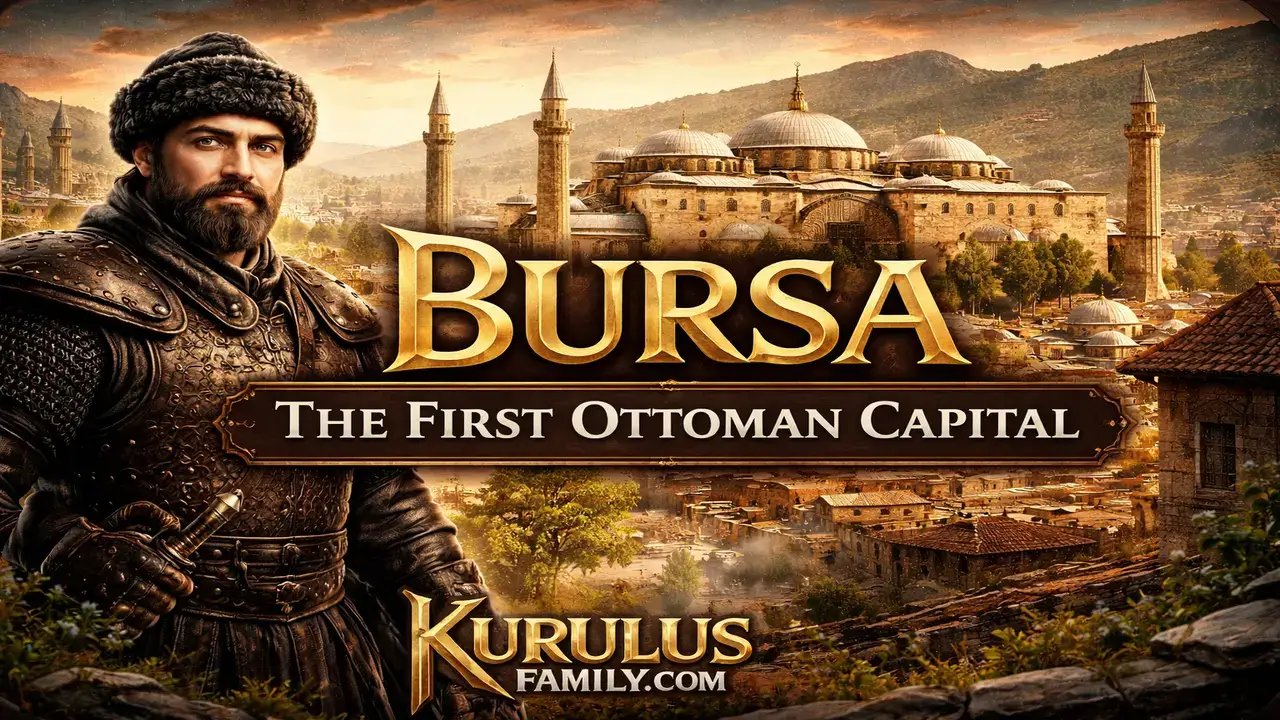
“When Orhan Ghazi captured Bursa in 1326, it became the first Bursa Ottoman capital — transforming a frontier principality into a structured and lasting state.”
Taking land creates opportunity. Organizing it creates power. Bursa was where that transformation began.
Bursa Before the Ottoman Conquest
Before its incorporation into Ottoman rule, Bursa was a Byzantine city known as Prusa. Located in northwestern Anatolia near the slopes of Mount Uludağ, it held both strategic and economic importance.
As part of the Byzantine Empire, the city served as a regional administrative center supported by fertile land and active trade routes. Its position made it a natural objective for any rising regional power.
The Capture of Bursa in 1326
The Ottoman capture of Bursa was not the result of a single decisive battle. Instead, it emerged from a prolonged effort to isolate the city and weaken its defenses.
Ottoman forces gradually cut supply lines and reduced external support, forcing the city into a vulnerable position. Although the campaign began during the final years of Osman’s leadership, Bursa ultimately fell under Orhan Ghazi in 1326.
This method—pressure over time rather than direct confrontation—would become a defining feature of early Ottoman expansion.
Bursa Ottoman Capital: The Foundation of Early Governance
With its capture, Bursa became the first true administrative center of the Ottoman state. This marked a shift from mobility to permanence.
Governance could now operate from a fixed location. Decisions about taxation, law, and military organization were no longer tied to movement across frontier zones. Instead, authority became continuous and structured.
This change allowed the Ottomans to move beyond survival and begin building stability.
Economic Growth and Trade Networks
Bursa quickly developed into a significant economic center. Its location connected inland Anatolia with routes leading toward Constantinople, making it a key node in regional trade.
The city became known for its textile production, especially silk, which contributed to its growing prosperity. Commercial activity expanded, providing the Ottoman administration with reliable revenue.
This economic base did more than enrich the state—it sustained its ability to govern and expand.
Urban Development and Cultural Identity
Under Ottoman control, Bursa began to reflect a distinct identity. Religious and public structures shaped the city’s physical and social environment.
Mosques, markets, and baths were constructed, transforming Bursa into a functioning urban center. The presence of the tomb of Osman Ghazi further reinforced its symbolic importance.
Bursa became a place where political authority, cultural expression, and historical memory converged.
Administrative Transformation Under Orhan Ghazi
The establishment of Bursa enabled significant administrative progress. Taxation became more regular, and legal structures began to emerge with greater clarity.
Urban governance expanded alongside rural management, creating a more integrated system of control. Authority gradually shifted from personal leadership to institutional support.
One of the clearest indicators of this transition is the minting of silver akçe coins around 1327. These coins confirm both economic organization and political sovereignty during Orhan’s reign.
Religious Policy and Social Stability
Bursa also illustrates the Ottoman approach to managing diverse communities. Different religious groups coexisted within a structured framework.
Non-Muslim populations were allowed to maintain their practices while contributing through taxation. This arrangement helped reduce resistance and maintain stability in newly incorporated territories.
Religious institutions also played a role in strengthening social cohesion and supporting education.
Bursa and Expansion Toward Europe
The stability established in Bursa made further expansion possible. With a functioning administrative base, the Ottomans could support campaigns beyond Anatolia.
This capacity contributed directly to the crossing into Europe through Gallipoli in the 1350s. The move marked the beginning of a new phase of Ottoman expansion into the Balkans.
Bursa did not simply support expansion—it made it sustainable.
Historical Sources and Interpretation
Much of the early history of Ottoman Bursa is preserved through later chroniclers such as Aşıkpaşazade and Neşri. While valuable, these accounts were written after the events they describe.
Modern historians, including Colin Imber, emphasize the importance of critical interpretation. Archaeological remains and coinage provide additional evidence, confirming Bursa’s central role in early Ottoman development.
Conclusion
Bursa’s importance lies not only in its capture but in what followed. It provided the Ottoman state with a stable center for administration, economic activity, and cultural development.
From this city, the Ottomans moved beyond the limits of a frontier principality and began functioning as a structured state. By the mid-14th century, that transformation had already reshaped their position in the region.
Bursa stands as the place where early Ottoman power became durable.
FAQs
Why was Bursa important to the Ottoman Empire?
Bursa served as the first Ottoman capital and provided the administrative and economic foundation for long-term expansion.
Who captured Bursa?
Bursa was captured in 1326 under the leadership of Orhan Ghazi.
What was Bursa known for?
Bursa became known for its trade, especially silk production, and its role as an early Ottoman cultural center.
Is Bursa still historically significant today?
Yes, Bursa remains an important historical city with key Ottoman landmarks and cultural heritage.
What is Bursa Ottoman capital known for?
Bursa Ottoman capital served as the first administrative center of the Ottoman state, providing governance, economic stability, and cultural identity from 1326 onward.